The Complexities of American Indian Identity in the 21st Century
Authors
Sean M. Daley, PhD, MA
Christine Makosky Daley, PhD, MA, SM
Ryan Goeckner, PhD, MA
Jason Hale, MA
Between 2011 and 2015, over 700 Native Americans from across the United States participated in Native 24/7, a mixed-methods study that delved into modern-day American Indian identities through semi-structured interviews with accompanying surveys.
Using the perspectives, voices, and stories of these participants, Daley and Daley document how contemporary Native peoples feel, define, and contribute to the construction of Native identity on topics such as colonization, tribal enrollment, blood quantum, language, spirituality, family, and community.
Lexington Books, Rowman & Littlefield
Date: March 15, 2023
ISBN: 9781793643872
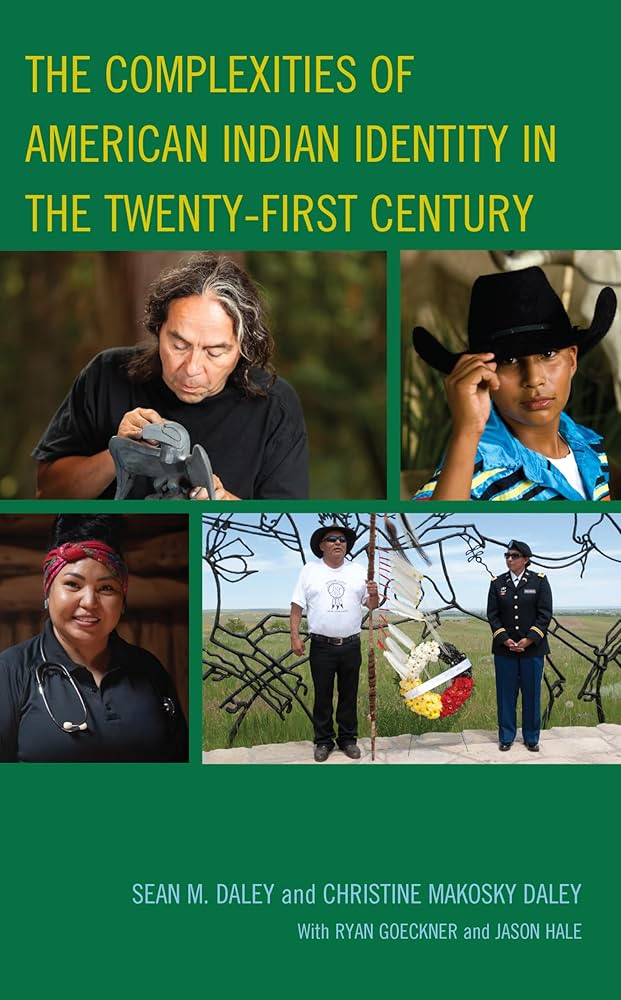
Table of Contents
- Methods and Participants
- “So, What Should I Call You? Indian? Native? Something else?
- “They’re Not On and Off Switches” Culture, History, and Heritage
- “Natives, We’re Good Relatives” Family, Community, and Relationships
- “I’m Only Indian On Sunday”
- “A Necessary Evil” Certificate of Degree of Indian Blood Cards
- “Football and Mascots” What We Have Learned
Reviews
“Who is an American Indian? Who is Choctaw? How do Indigenous individuals and communities think about and refer to themselves? Who gets to decide who one is? Who is believed? These difficult questions have long plagued individuals and scholars who have taken a taxonomic approach based on language or social affiliation to identify and define Native Americans. Individuals’ self-identifications are rarely taken into consideration in these classifications, and the many social roles individuals fill at different points in their lives or the necessary fluidity of categories for a heterogeneous population are not acknowledged. Finally, an excellent sociocultural study addresses these issues and their consequences. Anthropologists Sean M. Daley and Christie Makosky Daley spent years interviewing more than 700 individuals about their identities. The resulting book is a model for mixed-methods research, combining semi-structured interviews and surveys leading to the identification of social variables such as family, language, culture, personal preference, and the impact of life experiences. It demonstrates how personal and community identities serve as both protective shields and believable declarations of who a person is. Highly recommended. All readers.”―Choice Reviews
“At last! A detailed report illuminating the demographic, geographic, cultural characteristics of the diverse category of tribal citizens and non-citizens who identify as American Indian or Alaska Native. Grounded in many hundreds of qualitative and quantitative interviews, this welcome addition to the research literature also invites its participants to discuss what lies behind their shared identity assertion. Themes emerge related to ancestry, family and community connections, spiritual practice, relationships to the natural world, and more.” ―Eva Garroutte, Boston College
“This book makes an important contribution to a literature on Indigenous identity that had previously been primarily theoretical or grounded in personal experiences without systematic organization or analysis. The authors present data from a large, diverse, thoughtfully planned study, applying a robust yet not rigid methodology. The result is a clearly articulated multitude of voices describing complex, nuanced, and sometimes contradictory perspectives on Indigenous identity.” ―Hilary Weaver, professor emeritus, University at Buffalo

